
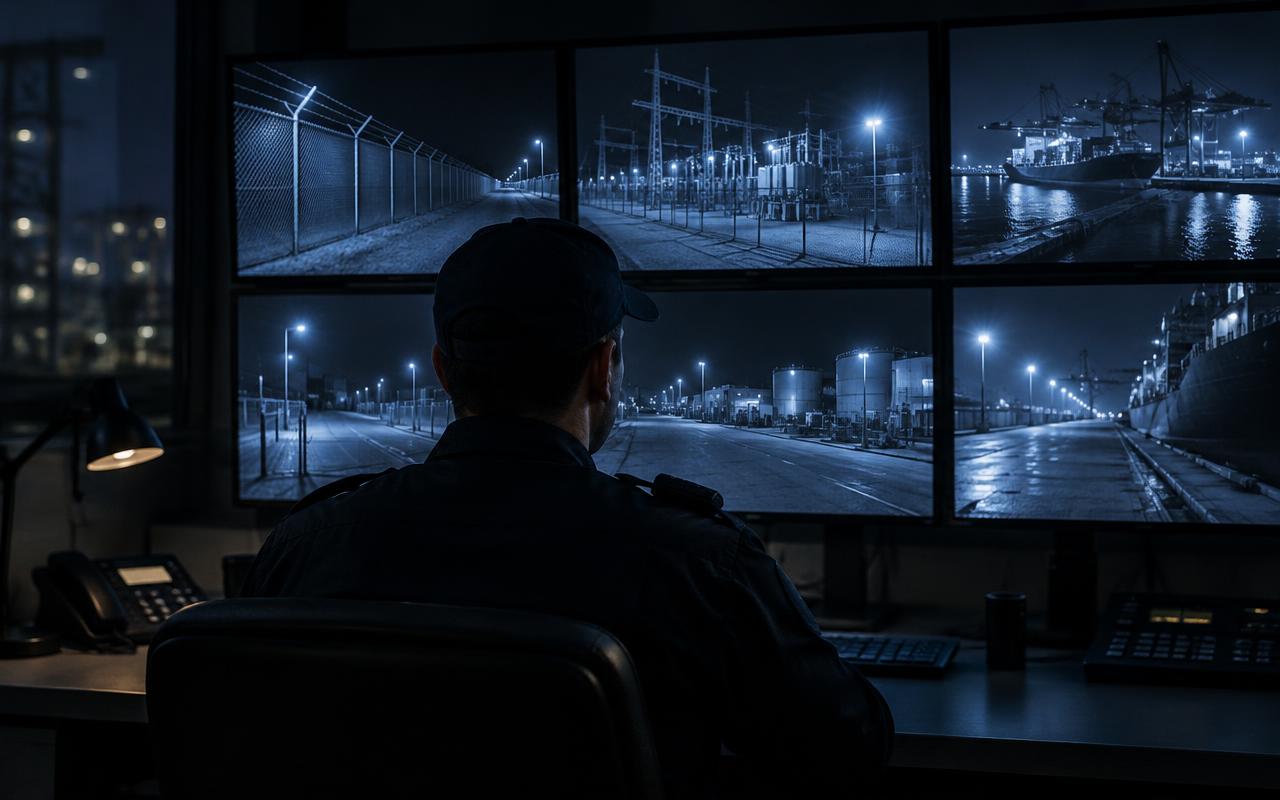
 Illustrative image
Physical world
Security guards and video monitoring
- Drone over a substation perimeter
- Vessel loitering near a cable landing
Handled on its own
Investor previewPrototype · not an operational service
Nation-state actors (Russia, China, North Korea and Iran) and criminal networks are targeting critical assets and infrastructure across the globe for espionage and intelligence collection. RAEFN is a counterintelligence capability being built to warn the people who protect those assets, across the physical and cyber domains, before an attack reaches its target.
The client experience is an illustrative simulation built on fictional synthetic data.
01 — The threat
Security managers in both the public and private sector are being increasingly challenged as these threats grow more numerous, more sophisticated and ultimately more consequential.
More numerous
Incidents against critical assets are being recorded more often each year.
More sophisticated
Attacks combine physical reconnaissance, sabotage and cyber intrusion.
More consequential
A hit on power, ports, cables or payments ripples far beyond one site.
In the news
Recorded attacks nearly tripled from 2023 to 2024, after quadrupling the year before.
Source: CSIS, “Russia’s Shadow War Against the West”, March 2025. Counts attacks and plots with intended physical effects, against all targets, not only infrastructure.
Headlines link to the original reporting. Attribution is as stated by the outlet or the officials it quotes.
02 — The customer's challenge
Critical assets and infrastructure typically rely on security guards and video monitoring in the physical world, and threat monitoring in the cyber world. These are the two domains where it is clearest where an attack could occur, and where it can be spotted early.
Illustrative imagePhysical world
Handled on its own
 Illustrative image
Cyber world
Handled on its own
Example warning signs come from the fictional client experience scenario.
The gap today
These systems are rarely connected in a holistic view that would reveal a sophisticated attack across domains.
They only provide perimeter defense, which means an attack has already breached the target before defenders react.
What RAEFN changes
RAEFN is being built to identify emerging threats and alert security managers to impending attacks before they happen, in real time.
Perimeter defense: alarm at the fence attack already under way
Early warning: pattern spotted defenders act before the target is reached
03 — What RAEFN is
RAEFN is uniquely designed and developed to answer these growing threats and provide safety and security for the key assets and infrastructure that drive our economies, ensure our democracies and protect our national sovereignty.
Protects critical assets and infrastructure with real-time indicators and warnings of emerging threats.
Uses commercial and internal datasets with AI fusion and analysis to identify threats before they reach their target.
Moves asset protection from perimeter defense to predictive modeling, through pattern analysis in the cyber and physical domains based on historical experience and precedent.
RAEFN is at prototype stage. These capabilities describe the product being built, not a service running today.
Product film
Video placeholder
Reserved for a future product film. No footage has been produced, and none is shown here.
04 — How it works
RAEFN analyses the data with AI, identifies the threats and passes that information to the client, together with suggested ways to reduce them.
Commercial and internal datasets covering the physical and cyber domains.
AI fusion and pattern analysis, grounded in historical precedent, identifies emerging threats.
The client receives the threat information in an agreed format. Indirect threats are shared without revealing other clients.
AI-generated suggestions to reduce the threat. The client's security managers decide what to do.
This is the proposed process. How real-time warnings are delivered, and how quickly clients act on them, is still being defined with the team. None of these steps runs in production today.
05 — Market footprint
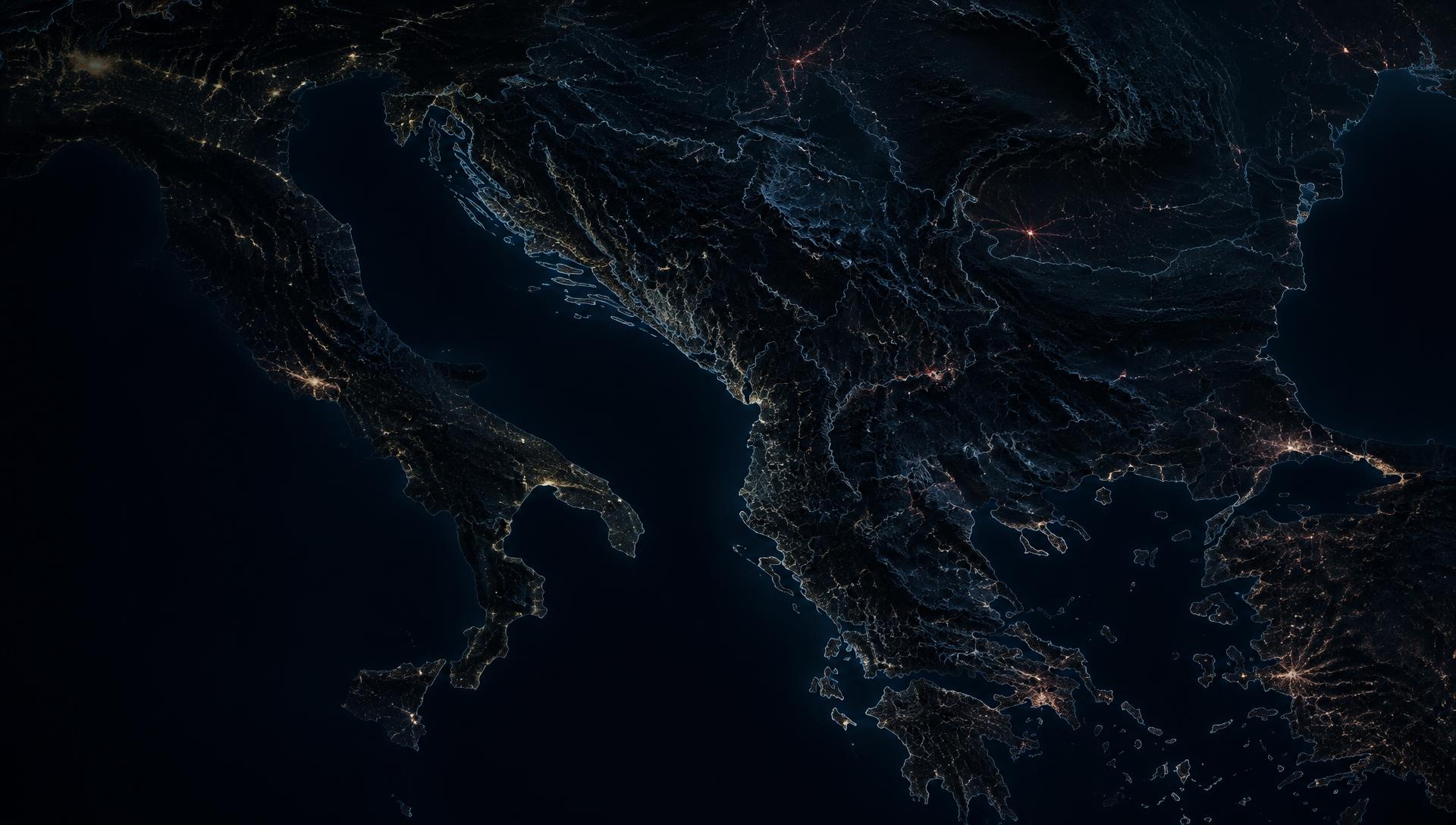
The initial proposed focus is six Southeast European markets. Their energy, transport, finance and telecom operators share grids, corridors and cables across borders, so a weakness in one country can quickly become a neighbour's problem.
Boundaries: Natural Earth (public domain), simplified. Illustrative only.
06 — Who it's for
The intended customers run the services a country cannot do without, and they depend on each other. A power fault can halt a port; a cut cable can stall payments. Each faces its own version of the same problem.
Grid, generation and pipeline operators
Port, rail, airport and logistics operators
Banks, payment and clearing providers
Network, subsea cable and coastal operators
Government and defence agencies
07 — Market context
Each target sector already spends on guards, monitoring and cyber defense. This chart sets RAEFN's hypothetical revenue against that spend.
Sector spend figures, as RAEFN defines security spend, are still being sourced. RAEFN's percentage of the total will be calculated automatically once they are added.
RAEFN's figure is the hypothetical model from the next section. It is not actual or projected revenue.
08 — Commercial opportunity
Below is a simple sizing exercise built on stated planning assumptions. It shows what the model could look like if those assumptions held. It is not a forecast.
Hypothetical — not actual revenue — not verified buyer counts — not traction
RAEFN has no customers, contracts or revenue. Prices, entity counts and license numbers are illustrative planning assumptions that have not been validated with buyers.
| Assumed price per sector subentity | $10k / month $120k / year |
|---|---|
| Illustrative sector entities (prior assumption) | 200 Not a verified buyer count |
| Hypothetical sector ARR | $24M 200 × $120k |
| Matching national-security licenses | 6 × $4M $24M combined — one per country, assumed |
Hypothetical total ARR
$48M*
$24M sector + $24M national security
* Illustrative output of the assumptions on the left. Not actual or projected revenue and not evidence of demand.
Needs to be proven
Buyer discovery
Confirm who in each sector would buy, and how they procure.
Needs to be proven
Price validation
Test the $10k / month assumption against budgets and alternatives.
Needs to be proven
Regulatory pathway
Confirm what data use is legally possible in each country.
09 — Use of funds
Startup capital pays for Phase 1: building, validating and deploying the first version of RAEFN with real operators.
Month 6 exit
Milestones are planning targets, still to be confirmed with the team. They are not results.
Budget: [Phase 1 amount and split — to be added]
10 — RAEFN people
RAEFN was founded at the crossroads of intelligence professionals solving real-world problems with nation-state actors, leveraging AI and commercial datasets.
RAEFN professionals combine skills from across the U.S. Intelligence Community with deep experience with nation-state actors, with cutting-edge technology advantages, and with a strong desire to scale these attributes for a better world.
Founder profiles
[Names, roles and backgrounds — to be added]
Individual profiles will appear here once the founders approve them.
11 — Privacy
Protecting infrastructure should never mean watching individuals. RAEFN is designed around that principle.
The datasets RAEFN uses, whether commercially procured or internally developed, mask the actual identity of individuals.
RAEFN is not interested in identities. It is interested in patterns that presage emerging threats.
Because RAEFN does not hold the identities of subjects of interest, it will not and cannot provide that data to clients or third parties.
Any future deployment would also depend on legal, regulatory and data-protection review in each country.
12 — Contact
Client experience
See what different clients would receive: a direct warning for threats to their own sites, and a confidential warning when a service they depend on is at risk.
Explore the client experienceInvestor contact
Contact details placeholder
A verified contact channel will be added here before the site is shared.